

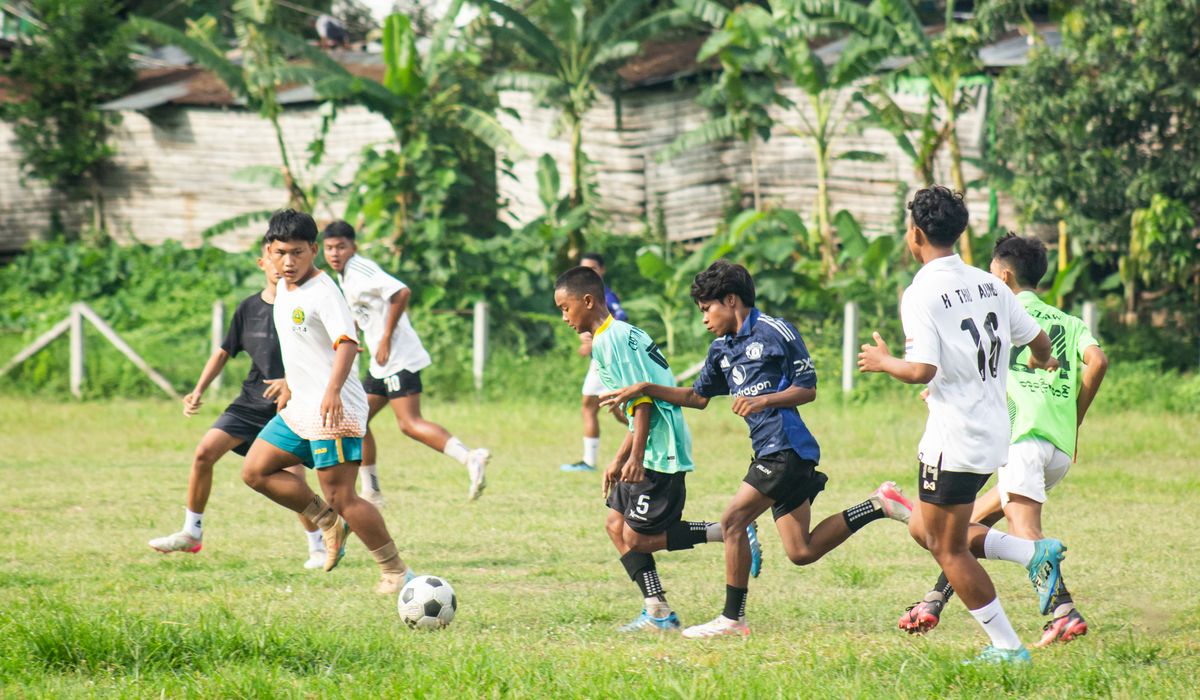
Why ball control comes before everything else
Ask any coach what separates a child who enjoys their football from one who drifts away from it, and the answer is usually the same: how comfortable they feel with the ball at their feet. A young player who can keep the ball close, take a clean first touch and look up has time on the pitch. Time to think, time to pass, time to try things. That is where confidence grows.
Ball control is not a gift. It is built through short, repeated, playful contact with the ball. For children between roughly five and twelve, twenty minutes of purposeful practice three or four times a week will do far more than one long session at the weekend. Keep it small, keep it fun, and keep the ball rolling.
Close dribbling: keep the ball within an arm's reach
Young players love to knock the ball five metres ahead and chase it. It feels fast, but it teaches them very little. Close dribbling — tiny touches, the ball never more than a stride away — is the foundation of everything else. Set up a space roughly the size of a tennis court and try these.
- Cone gates: scatter eight to ten pairs of cones a metre apart. Players dribble through as many gates as they can in sixty seconds, using both feet. Count the gates and ask them to beat their score next time.
- Traffic lights: on "green" they dribble, on "amber" they take small touches in a tight circle, on "red" they stop the ball dead with the sole of the foot. Add a "reverse" call for a sharp turn.
- Sole and inside: thirty seconds of ball rolls with the sole, thirty seconds of inside-of-the-foot touches, then thirty seconds alternating. This builds the footwork that later becomes a change of direction.
- One-v-one in a box: a five-by-five metre square, one defender, one attacker, thirty seconds each. No goals — just keeping the ball. Players learn to shield, turn and use their body.
Simple cues work best: "little touches", "knee over the ball", "head up every third touch". Keep your own instructions short and let them play.
First touch: teach the cushion, not the brick
A first touch should soften the ball and move it into space, not bounce it two metres away. The trick is to withdraw the foot or thigh slightly as the ball arrives, absorbing the pace rather than blocking it. Children find this easier to feel than to be told, so give them lots of goes.
- Wall work: a brick wall is the best free coach in Britain. Pass against it and control the return with the inside of the foot, then the outside, then the sole. Ten minutes a day, both feet.
- Serve and cushion: in pairs, one player rolls or throws the ball, the other takes a touch and passes back. Progress from a rolled ball on the floor to a gentle throw at chest height, controlling with the thigh, chest or laces.
- Touch into space: mark a small area with cones. The server plays the ball in; the receiver's first touch must take it outside the area. This teaches the half-turn and gets them facing forward.
- Two-touch rule: in small-sided games, insist on a maximum of two touches for a few minutes. It forces a good first touch because there is no time to fix a bad one.
Fun challenges that turn practice into play
Competition against themselves, rather than against each other, works brilliantly with this age group. Try a "skill of the week" — the Cruyff turn, a step-over, a drag-back — and let players earn a point every time they use it in a game. Keep a simple chart of personal bests: keepy-uppies, gates in a minute, successful first touches out of ten.
Small-sided games are the perfect testing ground. Two-v-two or three-v-three on a small pitch means every child gets dozens of touches instead of a handful. Add conditions that reward the skill you are coaching: a goal counts double if it comes from a first touch away from pressure, or if the player used their weaker foot. Finish every session with something chaotic and joyful — a dribbling relay, a knockout game, a shoot-out — so they leave wanting more.
Little and often: helping it stick
Improvement in ball control comes from frequency, not duration. A ball at home, a wall, a few minutes before school or after tea, and you have a training programme that costs nothing. Let children practise on different surfaces — grass, patio, the park — and in ordinary trainers as well as boots, because the ball behaves differently and their feet learn to adapt.
Praise effort and bravery, not just success. A child who tries a turn in a match and loses the ball has done something braver than one who plays safe. Keep sessions short, keep the language warm, and celebrate the small wins: the first clean first touch, the first time they beat a player with a change of direction. Those moments are what turn a hesitant youngster into a player who cannot wait to get the ball.





John Doe
14 January, 2022Having no content in post should have adverse..
Chauffina Carr
10 April, 2022We use these tests all time! Killer stuff!
Jim Séchen
16 July, 2022Thanks for all the comments, everyone!